My heart filled with anticipation as I saddled up for the final stretch before reaching the detachment depots. Although more centralized, the end of the Trail of Tears was similar to the beginning, a series of ending spots which differed by detachment.
According to Laurenda Joenks’ article, The Trail of Tears Marches On, “The Benge route ended at Mrs. Webber’s plantation near present-day Stilwell, Okla.; Bushyhead’s group disbanded at Beatties Prairie near Westville, Okla.; Bell’s route ended at the Latta house in Evansville, which is near Stilwell; and the Taylor group at Woodall’s near Westville. Cannon’s early group disbanded at Ms. Bean’s at Stilwell.”
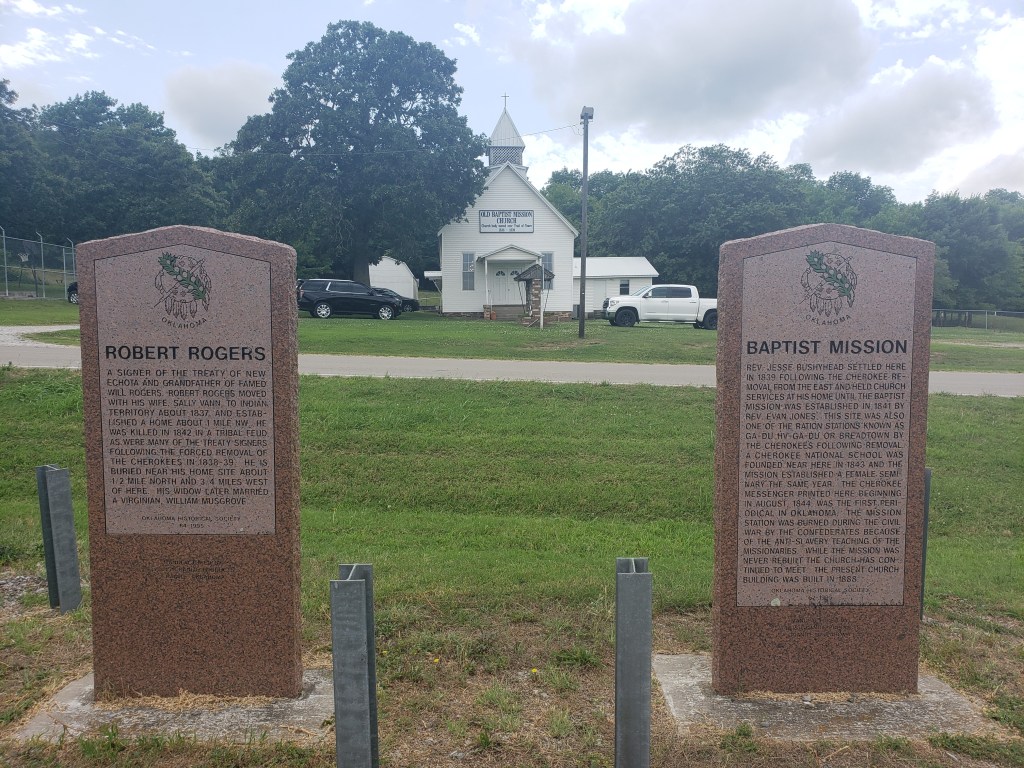
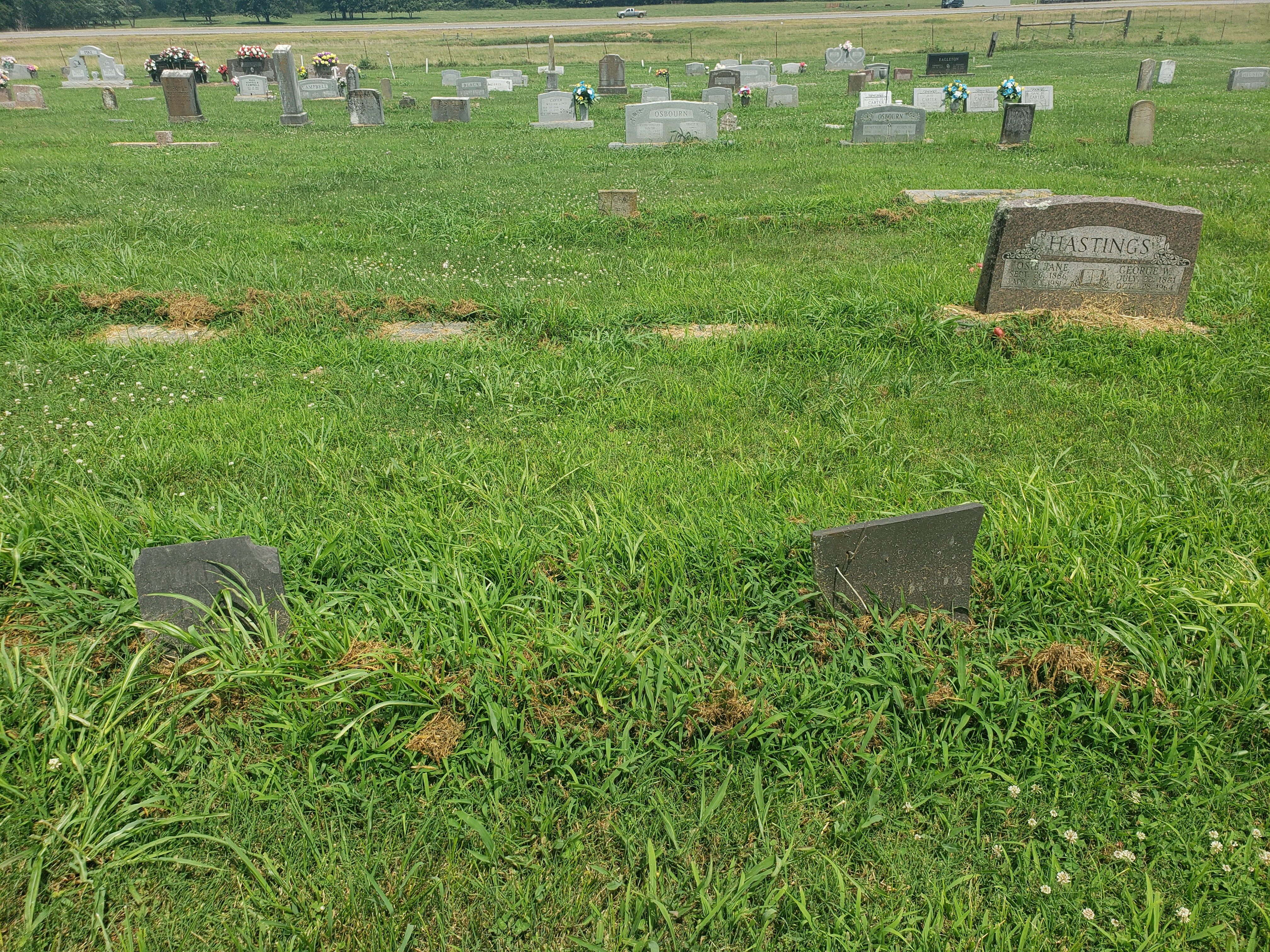
I set out to reach Westville and the Baptist Mission Cemetary first and then head to Stilwell to find Mrs. Webber’s plantation. For those that know me, it should come as no surprise that the skies opened up and poured rain down upon me for most of the journey to Westville. In Westville, I had a lovely chat with Patsy at the floral shop and a not so lovely ride over gravel terrain to the cemetary, which is in the middle of farmland about 4 miles north of town. I arrived about 2:30. I located Jesse Bushyhead’s grave and remarked on the sheer number of unreadable tombstones. I also noted how few of the tombstones marked people born before 1838. I wondered which of the few that were older were for survivors of the Trail.

I opened a circle, offered my prayer for the last time on the journey and spread the last remains of the marshmallow root that I had brought for the journey.
Although I felt complete in accomplishing my mission, the moment seemed a bit anti-climatic. I wondered if I was at the spot of Woodhall’s Depot and if there was anything more to see here.
I made myself some lunch and decided to approach a man in the church parking lot about the exact location of Woodall’s Depot. He didn’t know the answer but fetched his friend Chuck who knew more. Chuck indicated that Woodall’s was about 4 miles north and west in the woods somewhere not exactly known. Noting that, I headed back to my bike to head on Stilwell.
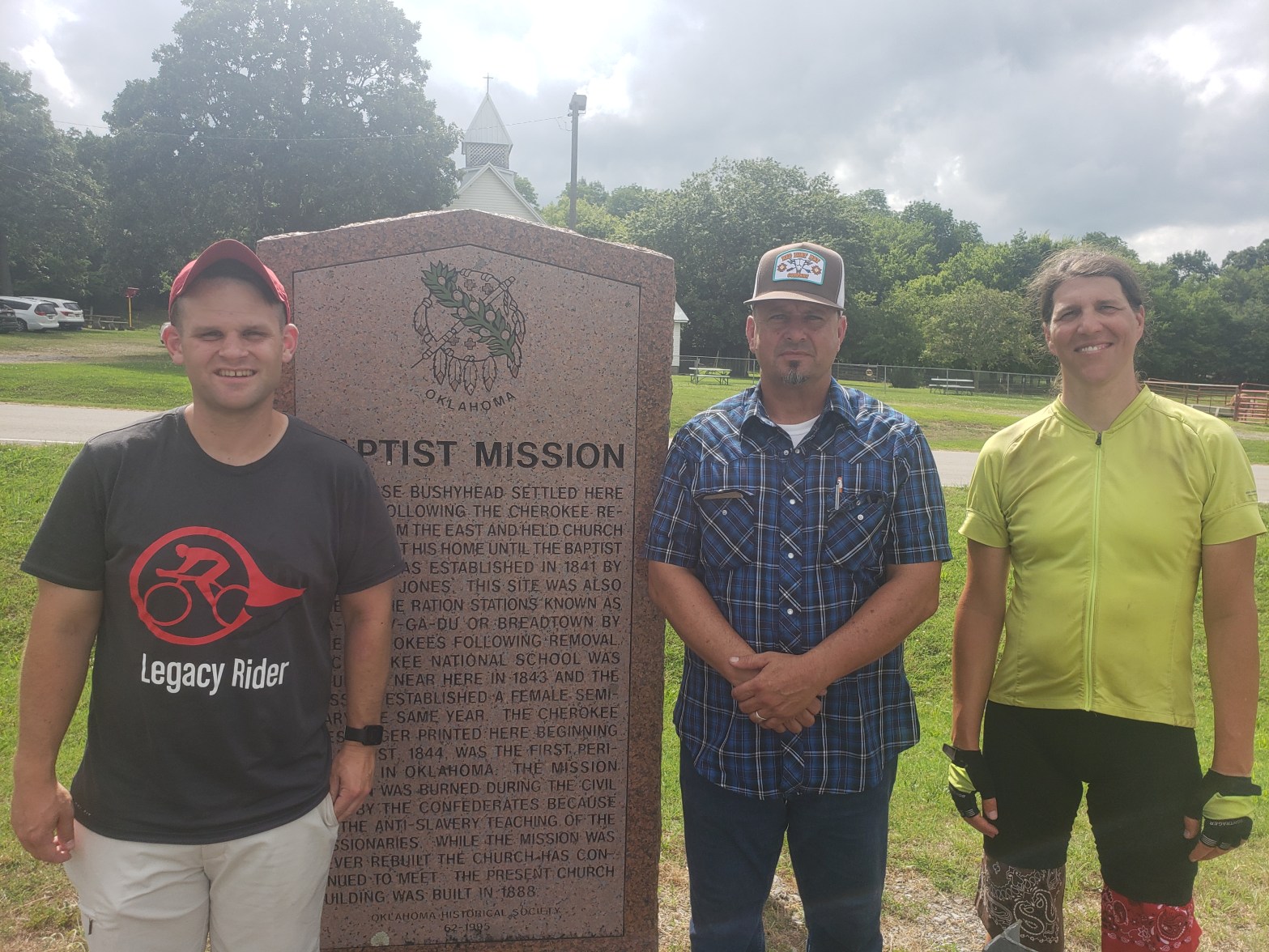
A pickup truck pulled up. Three men got out and sauntered over to one of the historical society markers. Out of the corner of my eye, I caught a glimpse of a familiar logo on one of their shirts. I asked the gentleman if I could see his shirt. Lo and behold, he was wearing a remember the removal rider shirt. I pointed to the shirt, with my jaw dropping, and then pointed to my bike and exclaimed that I had just biked from Georgia. Two of three men had participated in the remember the removal ride, and they were as excited to meet me as I was to meet them.
It turns out the one of the men was David Comingdeer, a candidate for Tribal Council District 7. David was filled with stories. The ones I remember the most were about the people after they arrived in Oklahoma. According to David, during the next year or so, there were enormous casualties amongst the people living in the disbandoment camps. All were dealing with severe PTSD, living in tents, and didn’t have any crops to share. They were entitled to a year’s worth of provisions that the US government had agreed to provide as part of the Treatyof New Echota, but the Cherokee had to go town, sign up and get a number before they were offered provisions. Many were assaulted by the white men in the area when they entered town. So many didn’t sign up for their provisions. Others lied about their blood quantum (the percentage of genetic history that native) because they were less likely to get beaten if they were even 1/8 white. It was another dark year indeed. I was thoroughly impressed with David and wish him all the best in the upcoming election. If I had a vote, I’d vote for David.

I offered my prayer of atonement to the three of them, and they received it. They offered me gifts. At first, I refused them, but they insisted. This is the way it should have been. If it had only been this way 200 years ago, then none of this tragedy would have ever happened, and the world would be a much more interesting place. Maybe my ride will help atone for that past and set an example of how it should be going forward.
All 3 of us were still in major awe about the synchronicity of running into each other at that time in that remote locale. I am still awed by David’s last name and the deer messenger that Spirit sent to call me to do this journey. I have a feeling that David and I may have the opportunity to collaborate on something in the future. Only time will tell.
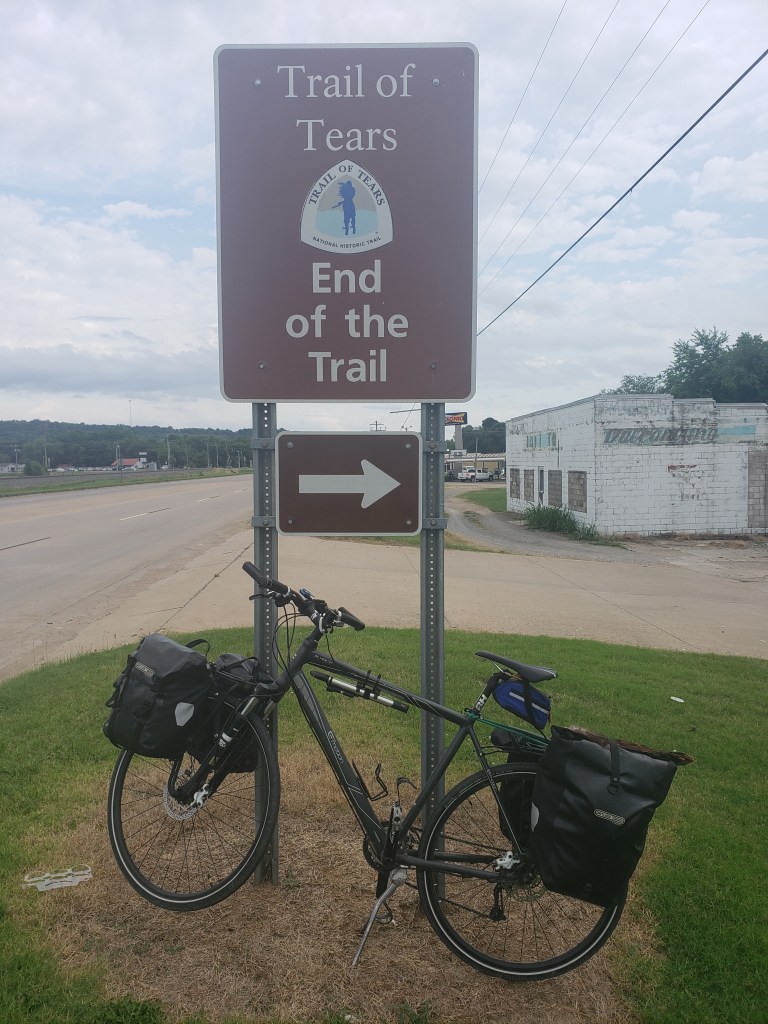
We parted ways, and I biked south to Stilwell in search of Webber’s Plantation. I found this sign instead. I poked around for a bit looking for more but found nothing. I declared it the end of my Trail of Tears journey. The following day I woild ride to Tahlequah, the capital of the Cherokee Nation and Keetowah Cherokees. Although not a part of the Trail, this journey would be necessary in understanding where and how the Cherokee of today dance with the ramifications of the Trail of Tears.
 Atone The Removal